A few years ago, “getting found online” meant one thing: ranking on Google. Today your buyers might type a question into Google, read an AI Overview, ask ChatGPT for a recommendation, or check Perplexity before they ever visit your website.
That shift has created a small mountain of acronyms. SEO, GEO, AEO and AIO all appear in sales pitches and LinkedIn posts, often used interchangeably. This guide explains what each one means, where they overlap, and what a growing B2B business should actually do about it.
The short version
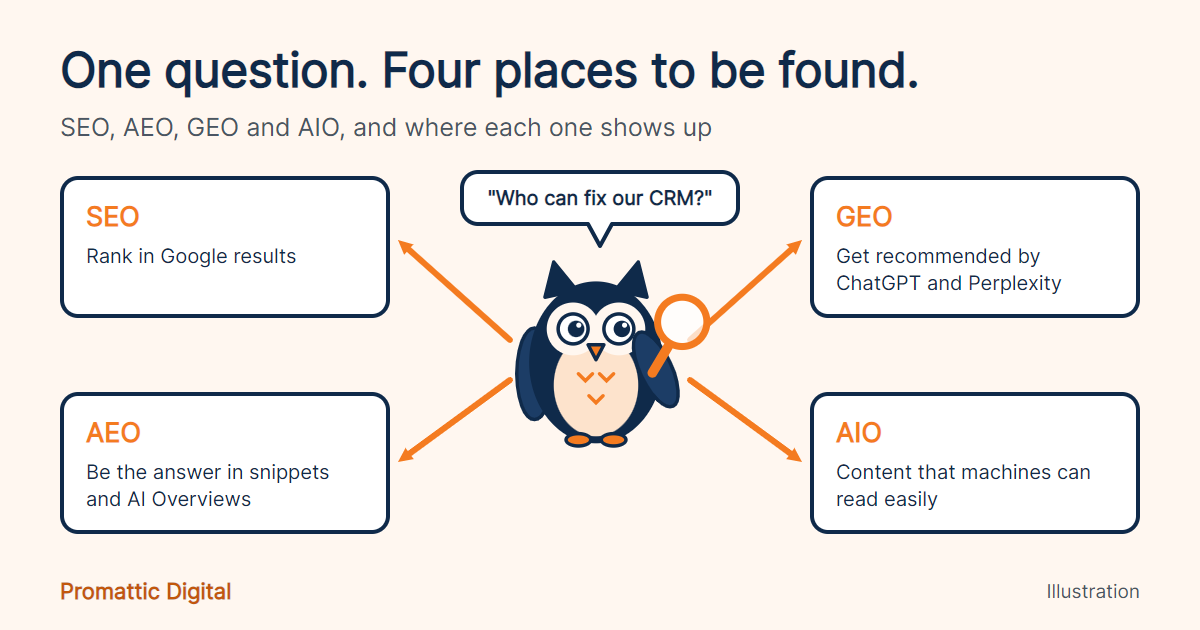
- SEO (search engine optimisation) helps your pages rank in search results.
- AEO (answer engine optimisation) helps your content become the answer: featured snippets, “People also ask” boxes and voice results.
- GEO (generative engine optimisation) helps you get mentioned or cited inside AI-generated answers from tools like ChatGPT, Gemini, Perplexity and Google’s AI Overviews.
- AIO (AI optimisation) is the least settled term. Some people use it for optimising for Google’s AI Overviews; others use it as an umbrella for making content easy for any AI system to read and trust.
There’s no official definition for most of these. Even Google treats optimising for AI search as part of SEO rather than a separate discipline. So rather than arguing about labels, it’s more useful to ask: where do my buyers look, and am I showing up there?
SEO: still the foundation
Classic SEO is about earning a high position in search results. It covers three areas:
- Technical health: fast pages, a clean site structure, mobile-friendly design, and no errors stopping search engines from reading your site.
- Content: pages that genuinely answer what people search for, in the words they use.
- Authority: links and mentions from other trusted websites.
SEO isn’t going away. AI tools lean heavily on content that already ranks and is trusted, so strong SEO makes everything else on this list easier.
AEO: become the answer, not just a result
Answer engine optimisation focuses on being selected, not just ranked. When someone asks “how much does cold email cost?”, Google may show a single highlighted answer above the results. AEO is about making your content the obvious choice for that spot.
In practice, AEO means:
- Building a list of the real questions your buyers ask.
- Answering each question clearly in the first sentence or two, then adding detail.
- Using FAQ sections and structured data (schema) so search engines understand the question-and-answer format.
GEO: get recommended by AI
Generative engine optimisation is the newest piece. When a buyer asks ChatGPT “who are the best HubSpot partners for logistics companies?”, the tool writes an answer and may name specific businesses or cite sources. GEO is about being one of them.
AI tools tend to mention businesses that are:
- Clearly described: your website says plainly what you do, who for, and where.
- Consistent across the web: the same name, services and details on your site, Google Business Profile, directories and social profiles.
- Referenced by others: reviews, industry articles, partner pages and lists that mention you.
- Specific and factual: pages with real numbers, examples and expertise are easier to quote than vague marketing copy.
Nobody can honestly guarantee that an AI tool will mention you. But you can make yourself a clear, trusted, well-cited source, which makes it much more likely.
AIO: making content machine-friendly
Because AIO means different things to different people, treat it as a reminder rather than a separate project: content should be easy for both humans and machines to understand. That means clear headings, short answer-first paragraphs, structured data, descriptive page titles, and facts that can be lifted into a summary without losing their meaning.
How they fit together
Think of it as layers. SEO is the foundation that gets your content found and trusted. AEO shapes that content into clear answers. GEO and AIO extend your reach into AI-generated responses. The same habits help all four: answer real questions, be specific, keep your details consistent, and earn mentions from credible places.
A practical plan for B2B businesses
- Check where you stand. Search for your main services on Google, then ask ChatGPT, Gemini and Perplexity the questions your buyers would ask. Note who gets mentioned.
- Fix the technical basics. Speed, mobile layout, broken pages and missing page titles still matter.
- Write down 20 to 30 buyer questions. Use sales calls, support emails and “People also ask” boxes for inspiration.
- Create answer-first pages. One clear answer up top, then the detail, examples and proof.
- Add structured data for your organisation, services and FAQs.
- Make your details consistent everywhere. Start with your Google Business Profile and the directories in your industry.
- Earn mentions. Reviews, guest articles, partner listings and podcasts all help AI tools see you as a trusted source.
- Measure what matters. Track rankings and AI mentions, but judge success by enquiries and pipeline.
The bottom line
You don’t need four separate strategies. You need one plan that makes you easy to find, easy to understand and easy to trust, for both people and machines. Get that right and the acronyms take care of themselves.
Want to know what Google and AI tools say about your business? Book a free 30-minute audit and we’ll show you where you stand and the three biggest opportunities.