
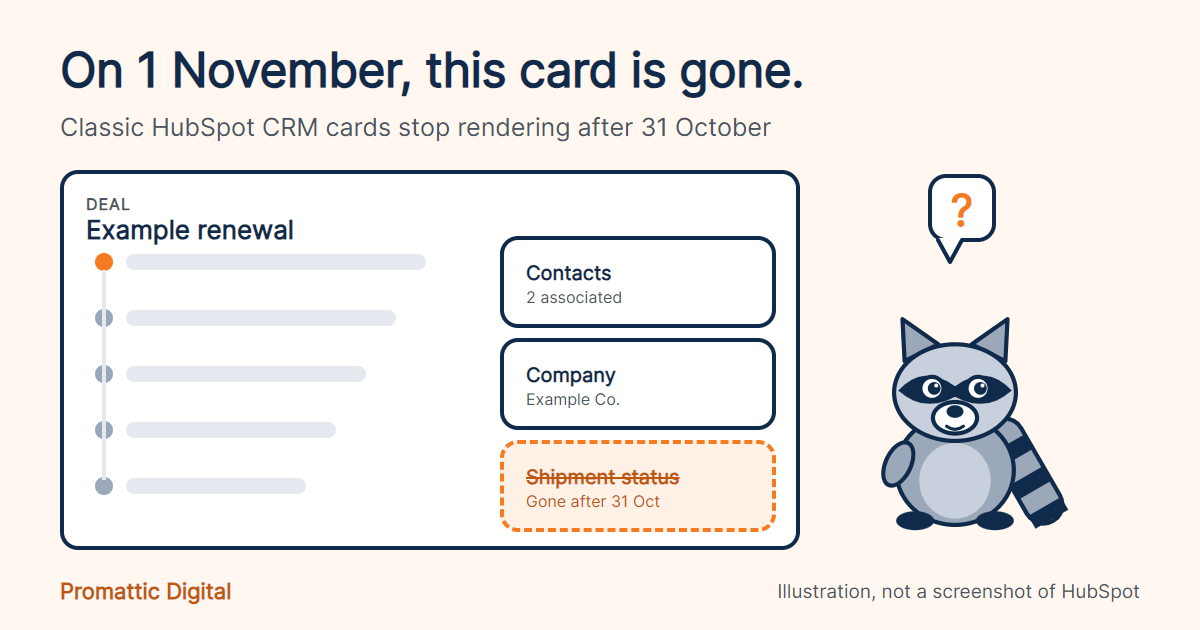
Say a logistics firm had a freelancer add a shipment-status card to the deal sidebar three years ago. Reps use it daily. The freelancer left, nobody has the code, and on 1 November the card is gone from every deal. [Made-up example, an illustration and not a client]
That is the one deadline in this post that can actually hurt. The other is milder. Both are dated, both come from HubSpot’s own developer changelog, and one of them is five days from the day I am writing this.
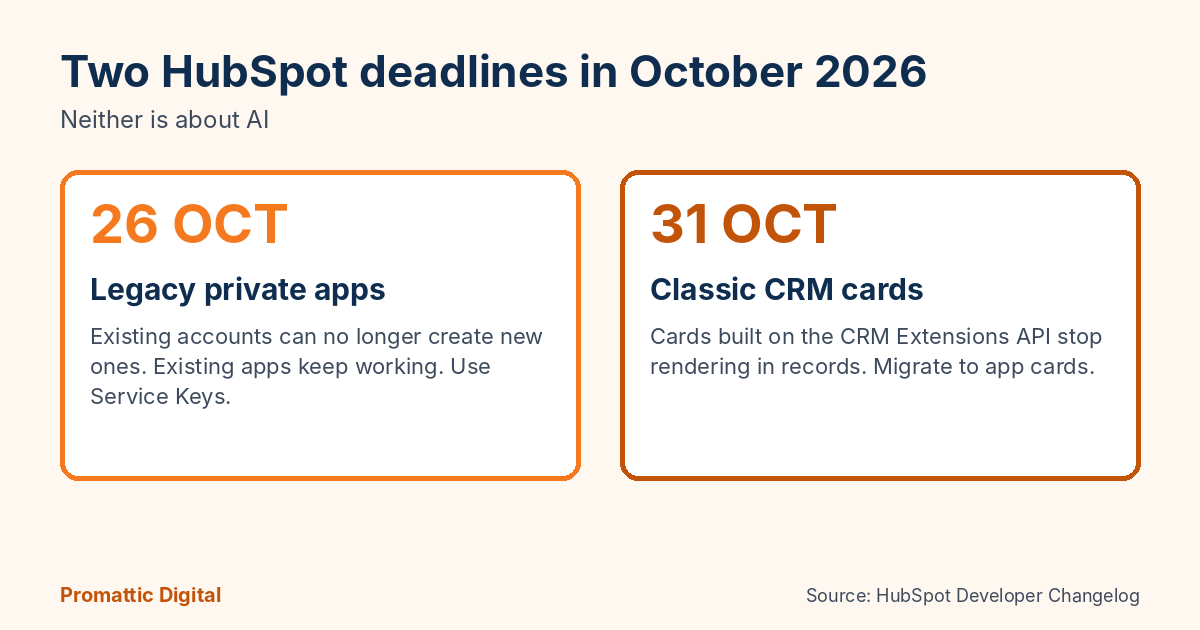
26 October: no new legacy private apps
HubSpot is permanently removing the option to create new legacy, non-Project-based private apps from the account UI. The timing depends on account age. Accounts created on or after 28 September 2026 lost the option on that date. Existing accounts lose it on 26 October 2026.
What does not change: every existing legacy private app keeps working. HubSpot says this only removes the ability to create new ones.
For new in-account integrations, HubSpot points to Service Keys, available through Developer Platform Projects version 2026.09 or later, for system-to-system integrations. You create one under Settings, Integrations, Service Keys.
Who this affects: whoever builds or maintains your integrations. If nobody does, you will probably never notice.
31 October: classic CRM cards stop rendering
This is the bigger one. HubSpot’s May 2026 developer rollup says legacy CRM cards built with the CRM Extensions API stop being supported on 31 October 2026. After that date, they no longer render in CRM records, and the endpoints that support them are removed. The deprecation was first announced on 15 May 2025, so nobody can say HubSpot did not warn us.
Only cards created through the legacy CRM Extensions API are affected. If your portal uses a marketplace app or custom integration that put a card on the record sidebar, that may be one of them.
HubSpot has tools for developers. There is a Legacy CRM Card Converter sample on GitHub, and since 21 April 2026 a View Swapping Tool that replaces a legacy card with a UI extension app card without breaking existing customer views. It needs the app to be on the Projects Framework, version 2026.03 or later. If a legacy card is not removed, it gets hidden automatically on 31 October.
One more date for anyone with an app listed in the HubSpot marketplace: from 2 November 2026, apps need to be on a supported developer platform version, which HubSpot lists as v2025.2 or v2026.03.
What to do this week
- In HubSpot, open Development, then Legacy apps, and list every legacy private and public app in your account.
- For each app, write down who built it, what it connects to and who uses it daily.
- In the app’s developer account, open Apps, then CRM cards, and check for classic cards.
- Ask the vendor or developer for their app-card migration date, in writing.
- For any new integration after 26 October, use a Service Key, not a legacy private app.
- Test migrated cards in a developer account before 31 October.
- Leave existing private apps alone for now, and plan their move to the Projects platform for later.
Where this goes wrong
The usual failure is orphaned work. A card or app that nobody owns, built by someone who has left, discovered by a rep on 1 November asking where the panel went.
Ownership is the fix. For each app, one named person at your company who answers for it.
We run HubSpot and CRM clean-ups as part of wider RevOps work, and this kind of audit is a good use of the free 30-minute growth audit. We are not a HubSpot partner, so you will get an honest read, and we will say if you have nothing to fix.
Check HubSpot’s developer changelog before acting, since dates can move. This post was last checked on 21 October 2026.
FAQ
What happens to HubSpot legacy CRM cards on 31 October 2026?
Classic CRM cards built with the CRM Extensions API stop rendering in CRM records, and the endpoints that support them are removed. Apps must migrate to app cards built with HubSpot’s UI extensions. Cards not removed are hidden automatically on that date.
Will my existing legacy private apps stop working on 26 October?
No. HubSpot says all existing legacy private apps continue to work. From 26 October 2026, existing accounts simply cannot create new legacy private apps through the account UI. New integrations should use Service Keys. Plan the migration of existing apps for later, without rushing it.
How do I find out if I have classic CRM cards?
In HubSpot, go to Development, then Legacy apps, to review legacy apps. In the developer account where an app was built, open Apps and then CRM cards. Then ask your developers or vendors which apps use the CRM Extensions API.
Sources
- HubSpot Developer Changelog, Legacy Private App Creation Being Disabled
- HubSpot Developer Changelog, May 2026 Rollup, Legacy CRM Cards Deprecation
- HubSpot Developer Changelog, April 2026 Rollup, View Swapping Tool
- HubSpot Developer Changelog, App Listing and Certification Requirement Updates for May 2026
- HubSpot Developer Docs, Legacy apps overview